Showing posts with label history. Show all posts

November 19, 2013

Hidden treasures, in plain sight: The City Hall subway stop

If you've spent any time in NYC, you know the subway stations aren't its best ambassador to visitors. Sure, some of them are quite alright, but generally they're pretty stuffy, raggedy-looking places.  The 7th Avenue station in Manhattan in particular is usually nice and stinky.

Not exactly built to awe and inspire.

There is one station, though, which was designed to do just that -- awe and inspire, wake up all of your urban beauty sensors, and showcase how much of which the city was capable. It just hasn't seen a passenger in 70 years.


The City Hall station was once a part of the Lexington Avenue line, and was built to be the jewel in the crown of the subway system.  The first subway was launched from this station in 1904, with Mayor George McClellan at its controls.


The station is all arches, brass fixtures, and chandeliers.  It's peppered with skylights to let in the sun (which, fun facts, were covered over with tar during the Second World War for blackouts).  On the walls, there are plaques commemorating the achievement of the building of the subway system itself. 


Despite its grandeur, it served relatively few passengers, since it was very close on the same line to the much busier Brooklyn Bridge station.  In the 1940s, an increase in subway users led the city to longer trains, and as a result, longer platforms.  The curve of the City Hall station made for a dangerous gap between the car and platform with these longer trains.  Given the renovations and money which would have been required to bring the station into line with the newer trains, and its relative lack of use, the city decided simply to close the station.  It saw its last departing train on New Year's Eve, 1945.


For a long time, the station lay completely abandoned.  After the New York Transit Museum was established in 1976, it ran occasional tours of the station.  There have been rumors and rumblings periodically of the station being restored and turned into a museum, most recently and seriously in 1995, when the Transit Museum applied for funding to set it up as a museum annex.  None of these plans have ever come to fruition, due most recently to a 1998 decision by Mayor Rudy Giuliani - fearful of its proximity to City Hall and its vulnerability to potential terrorist attacks - to declare it part of a "highly secure area" around City Hall.  Tours resumed in 2006, but are only available to members of the Transit Museum.


But never fear!  You can still see the station today!  The current 6 train still uses the City Hall station as its turning loop.  For years, MTA staff required all passengers to get off the downtown train at Brooklyn Bridge, which is the last stop on its line.  Today you are allowed to remain on the train while it goes around its loop through City Hall and around to the uptown platform at Brooklyn Bridge.

Which means, if you find yourself heading downtown on the 6, don't get off at the last station!  Stay on for an extra few minutes and treat yourself to a peek of this abandoned New York treasure.

In the meantime, you can treat yourself to this photo of the station in its heyday, right after its construction in 1904. 


What's your favourite public hidden gem?

A quick note:  All of the photos, with the exception of the last one, were taken from James Maher.  He takes really lovely photos of the city.  A number of his photos are available to buy as prints, so if you liked what you saw in this post, maybe head over to his site and see whether he has a frameable of your favourite landmark.  (By the way, this isn't an ad -- I'm completely unaffiliated with him, I just like people who take pretty pictures of this city.)  The last photo came from The Atlantic.

November 15, 2013

Read this: Tony Judt on NYC & "world cities"

Today I'm just going to leave you with a little Tony Judt, because he can express how I'm feeling a lot better than I can.  If you aren't familiar, he was a wonderful historian and essayist.  He was born in London, moved to New York in 1982 to teach at NYU.  He was diagnosed with ALS, or Lou Gherig's disease, in 2008 and died in August of 2010, at only 62 years old.

If you want to learn about postwar Europe - and come to understand your world much better for it - read his Postwar.  In fact, if you only ever read one history book, make it Tony Judt's Postwar.

This essay is taken from his autobiographical work The Memory Chalet, and was printed in the New York Times on November 8th, 2010.  Read it here.


"Chance made me an American, but I chose to be a New Yorker. I probably always was."
- Tony Judt (1948 - 2010)

October 17, 2013

This week in History: Revolution, Retribution, Justice?

This week in history, a lot went down.  While there were plenty of fun and interesting things that happened -- the rules of American football were made official and Jacqueline Kennedy married Aristotle Onassis -- the common thread in this week's anniversaries seems to me to be one of retribution and justice.  On the days between October 14th and October 20th, the world has seen in particular, a number of attempts at bringing about justice through the execution of deposed leaders.

On October 15th:
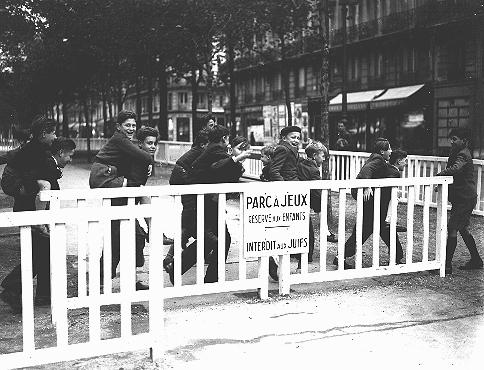
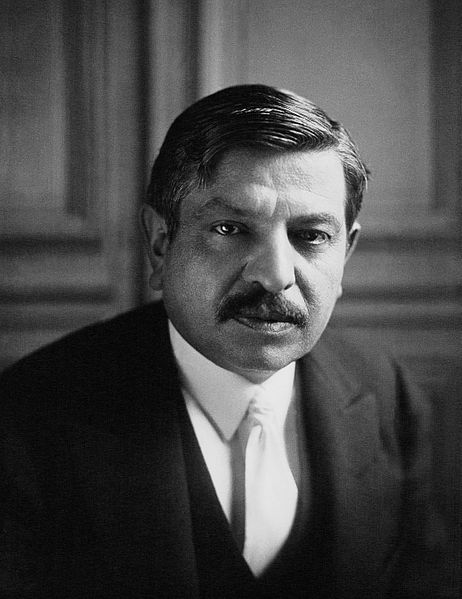
In 1945,  Pierre Laval was executed by a firing squad for his colllaboration with the Germans during the war.  Laval had been Prime Minister of France for about a year in 1931, and again in 1935 and 1936.  Although he began his political career as a socialist, his views drifted radically to the right, and he later served the Vichy regime after France's 1940 surrender to the Nazis.  He was the head of this government from 1942 to 1944.  Laval was deeply involved in the persecution of France's Jews, and signed the orders which deported French Jews to Germany and death camps.


Laval's portrait, and a sign bans Jewish children from a French playground.

On October 16th:
 In 1793, Marie Antoinette was beheaded by guillotine as part of the French Revolution.  For a little more on her, take a look at this list of "Ten things you might not know about Marie Antoinette," posted on the History Channel's website yesterday.

A 1779 portrait, and Marie Antoinette being led to the gallows

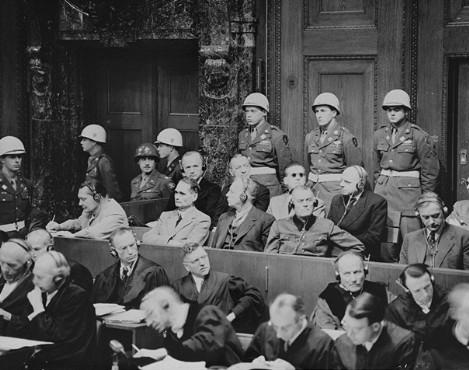
In 1946, ten Nazi leaders were hanged for war crimes in Nuremberg, Germany.  The ten men were Hans Frank, Governor-General of Occupied Poland; Wilhelm Frick, Minister of the Interior;  Hermann Goering, commander of the German air force and Hitler's designated successor; Alfred Jodl, leader of the army; Wilhelm Keitel, de facto defense minister; Joachim Von Ribbentrop, Foreign Affairs Minsiter; Ernst Kaltenbrunner, the highest-ranking SS leader remaining; Alfred Rosenberg, Minister of the Eastern Occupied Territories; Friz Sauckel, head of the slave labour program; Arthur Seyss-Inquart, Commissioner for the Occupied Netherlands; and Julius Streicher, Gauleiter of Franconia and publisher of the anti-semitic newspaper Der Stuermer.  Martin Bormann, Nazi Party Secretary, was sentenced to death, although he was not present for the trial.  His remains were found in 1972, and it is believed that he committed suicide in 1945.

The Nuremberg "Palace of Justice," where the trials took place, and the defendants at trial.

On October 19th:
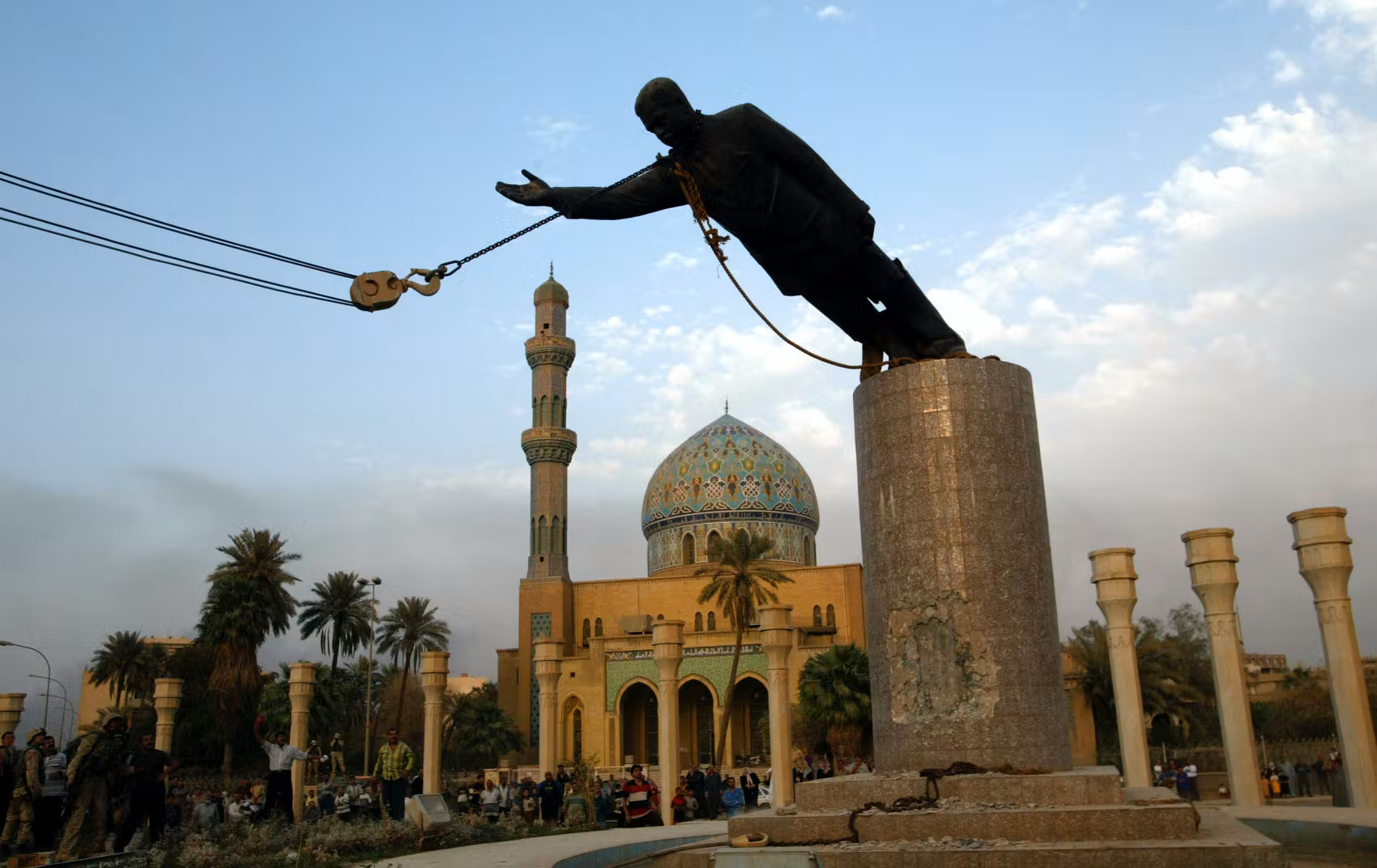
In 2005, Saddam Hussein's trial for crimes against humanity began in Baghdad.  The trial, conducted by the interim Iraqi government, was deemed "unfair" by Amnesty International, and was marked by Human Rights Watch as a significant step away from the rule of law in Iraq.  Hussein was hanged on December 30th of that year.

Hussein at his trial, and his famous statue in Baghdad is torn down.

On October 20th:
In 2011, Libyan rebels captured the overthrown dictator Muammar Gaddafi in his hometown, and killed him.  Photos of Gaddafi dead in a ditch were circulated immediately after.  The fact that I won't repost those photos here tells you something about my opinion on how much justice is really served by assassination, and the justification of distributing such images for general consumption.  

Was the execution of these former leaders justice, or vengeance?  Is the execution of a figure deemed to have acted in a way which is either murderous or treasonous always justified?  Is it appropriate and necessary action following a trial, or is a trial unnecessary?  What legitimises the decision, or even the trial itself?  Or is execution never an appropriate way of dealing with criminals, of any proportion?  I don't have any answers.  Given the anniversaries we see this week, it seems like an appropriate time to take a few minutes to ponder what you think on what justice means. 


October 07, 2013

A Little Context: Government Shutdowns in History

Unless you've been living under a rock without a smartphone, you're aware that the government of the United States is currently closed for business.  Our current shutdown is the result of the desire of the Republican-controlled House to stop, or at the very least slow down, the launch of the Affordable Care Act, otherwise known as Obamacare.  I'm not going to go into the whys, wherefores, and whose-faults here, mostly because I've just recovered from a very stressful week and thinking too much about the Republicans currently in Congress is only going to bring my blood pressure back up. I'll let Jon Stewart do that for me; he's much better at it anyway:


Instead, we're going to take a little look at some of the reasons why our Government has shut down in the past.  Government shuts down as the result of an inability of Congress and the President to agree on a budget, or "spending bill."  The current process required to pass a spending bill was implemented in 1976, which is the reason why shut downs began after this date.  Before the 1980s, however, threats of shutdown were not taken particularly seriously.  In times of political conflict the offices of government, as well as the American people, worked on the assumption that Congress would pass a spending bill eventually, and just went about their work as normal.  That all changed in 1980 when Benjamin Civiletti, Attorney General under Jimmy Carter, declared that government work could not go on unless Congress has agreed to pay for it.  Those who continued to work for the government during a shutdown, or "spending gap," were classified as "illegal volunteers" and could not legally continue their work until the political resolution of a spending bill.  This was later softened by a second legal opinion from Civiletti, stating that all "essential" government services could continue work.  These "essential" workers report to work as normal through the shutdown.  Even with this adjustment, Civiletti significantly raised the stakes in future disputes over government spending bills, compelling politicians to reach consensus on spending bills more quickly than they had during the 1970s.

September 29, 2013

Surprisingly wonderful: Drunk History


I first saw Drunk History about a year ago on Youtube, when my boyfriend insisted that I watch this hilarious video.  I have to say, I wasn't impressed.  For one thing, I don't get that much enjoyment out of watching people stumble around absolutely blackout - all I felt was second-hand embarrassment.  You know when you've had a big night, and you see a photo of yourself the following morning, all flushed, probably sweaty, and frizzy?  You're inevitably yelling about some story that you think everyone just HAS to hear.  I'm shrinking in shame just thinking about it.  I didn't love the original Drunk History videos because they seemed to put too much emphasis on the drunkenness of their storytellers, and not enough on the history itself.  The stories people were telling were being completely lost in their garbles and stumbles.  

So when I saw a billboard for Drunk History, the new show on Comedy Central, I didn't have high hopes, even when the advertisement itself was pretty fantastic:

Nixon knows how to party.  Image via

My boyfriend insisted again, though. ("I just don't understand how you don't like it!  You love history, and you love drinking!" Always lovely to know what others think of you.)  To my surprise, I enjoyed the new show.  I found myself not arguing when he wanted to watch it, and then even suggesting it myself.  

There are still plenty of cringe-worthy moments, but the quality of the storytelling has changed.  Our theory is that they now record the story twice, first when they're only in the process of getting drunk, and then again once they're really wasted.  Whatever the change is, the result is that they now get the story across in a coherent enough way hat you can actually learn something from it!  And that's what I love about this show.

History so often gets a reputation for being boring - memorising dates; dead white men; stories about the distant past without the context that makes them interesting, and timeless.  We need more fun and sillly ways to teach history, because History should be fun, and is very often silly.  Drunk History is doing just that - telling the stories we all probably should know about our country in a way that makes them engaging and accessible to everyone - even the very inebriated.  

You can watch it here.

August 22, 2013

Catch-up & Drinks to Die For

Sorry for the radio silence this week, I took an impromtu escape trip to Maryland for a few days.  It was exactly what I needed!  Even though I love NYC, anyone who lives here will tell you that it's always nice to get out for a little while - particularly in August.  I spent the week making big dinners and margaritas, playing cards against humanity with friends, and catching an Orioles game!

Full disclosure: this was taken after we moved into the better seats towards the end of the game

Now that we're back in action, here's something interesting going on in the city today:

Drinks to Die For

Cue the organ music.  Image via

The Brooklyn Historical Society has been hosting this somewhat macabre happy hour in Greenwood Cemetery all summer, and tonight is the last night!  From 6 to 8pm, you can grab a $5 beer from Brooklyn Brewery and enjoy some live music in Brooklyn's massive cemetery park.

Unfortunately I can't make it out there tonight, but if you do, please leave your thoughts on what it's like to drink and dance with hundreds of years of New York's deceased.

August 15, 2013

Blackout

Ten years ago this week, the lights went out throughout much of the Northeast in a massive blackout.  At 4:10pm on August 14th, 2003, a power line which was already sagging from the summer heat came into contact with a falling tree branch and short-circuited.  From a combination of technical struggles and human balls-ups in reaction to that one short-circuit, more than 10 million people in Canada and 45 million people in the U.S. lost power.  For some, power was restored by 11pm that day, but for others it would take days.

NY Daily News, the day after the blackout.  Image via

August 10, 2013

This week in History: Badass ladies edition


This past week has seen a lot of anniversaries, the 1945 atomic bombings of Hiroshima and Nagasaki chief among them.  While it's been a big week for sombre rememberance, these last seven days in history have also seen a lot of amazing women do great things.  Here's a few of them:

1.  In the Supreme Court

20 years ago today, Ruth Bader Ginsburg was sworn in as the second female Supreme Court Justice in history.

RBG, looking awesome as a Justice today, and as a senior at Cornell in 1954.  
Photos from Wikimedia Commons and Huffington Post


2.  You Strike a Woman, you Strike a Rock

Yesterday was South Africa's National Women's Day, in commemoration of a 1956 march by women in Pretoria to protest laws requiring people to carry the "pass," documentation papers intended to curtail the freedom of movement of black South Africans during apartheid.  


Demonstrators sang a song written for the occasion, and a version of its name - "you strike a woman, you strike a rock" - has become emblematic of the strength and power of women in South Africa.

3.  The White Mouse

On August 7th, two years ago, the world lost an incredible force of nature:  Nancy Wake.

 
Photos from NYTimes & Badassoftheweek.com respectively.

Nancy Wake was a British secret agent during the Second World War.  Born in New Zealand in 1912, she was raised in Australia, and moved to France at 20, where she married a wealthy industrialist named Henri Fiocca.  When the war hit France, she used her wealth and influence to make food from the black market accessible to the people of Marseille, where she lived.  She progressed from smuggling food to people, and aided in the escape of French Resistance and British POWs from a nearby German prison.  When the local Nazis began to realise what she was up to, she fled through Spain to Britain, where she joined the elite Special Operations Executive.  After training with SOE, she returned to France, where she worked with resistance fighters in Auvergne.

By 1943, Wake was at the top of the Gestapo's most wanted list, with a five-million franc reward for her death or capture.  Her nickname among the Germans was the "White Mouse," because she consistently evaded capture.  

Nancy Wake is one of my favourite figures in history - keep your eye out for a more in-depth bio on this amazing woman soon!


Who is your favourite woman in history?  Is there a recent lady BAMF anniversary you'd like to see added to this list?


August 06, 2013

Who's buried in Grant's tomb?

Another of my early OMGWTFISTHIS moments in New York was early in my freshman year at Barnard, when I was out on a walk and came across Grant's Tomb.

Being a fresh-off-the-boat Australian, I had absolutely no idea what I was looking at.  I was just surprised to see this big, grand-looking structure which wasn't a part of the university at all.  I went in, had a quick chat to the friendly lady at the desk, and took a look around.  I had the place to myself, so I was totally free to take my time catching up on a couple hundred years of history in my new country.  

[photo via the Library of Congress]

This photograph was taken at its dedication, in 1897.  It's a remarkable monument to one man, even a very important man.  Even more remarkable to me is the way that the city has grown up around it.  All of those wide open spaces in the background are now occupied by apartment buildings, as well as the campuses and dorms of Columbia, Barnard, the Union Theological Seminary, and the Manhattan School of Music.  


Grant's Tomb, rocking my Instagram since I got Instagram.  Photo taken last fall.

This space is one of my favourite places in the city.  It's magnificent, and yet hardly anything goes on here.  The most attention you're likely to see this place receive on any given day is from local arts students taking advantage of the setting, or the occasional double-decker tour bus driving by.  There aren't many better places to sit with a coffee and your dog while you ponder your life.  


The lack of a busy stream of tourists is one of the great and strange things about Grant's Tomb.  The result is that once you step through its great big doors, you're no longer in New York City.  You feel like this place could be anywhere in the country - except for where you actually are.

What's the most interesting monument you've seen?


August 05, 2013

Hidden treasures, in plain sight

Have you ever turned a corner and been taken aback by something which seems completely out of place?  It could be a building, a monument, or anything at all that makes you stop and say, "woah!  What is that?"

It's one of my favourite feelings.  You feel like you must be the only person who sees that this thing is there.  You have to be-- why isn't anyone else freaking out?!  You immediately start to wonder what its purpose is, or was, who created it, and the stories it would tell you, if only it could.

Of course, you're not the only person who knows it's there.  Everyone else is perfectly aware of its existence and would really prefer that you stop gaping in the middle of the sidewalk and get out of their way.  But try telling me that in this moment.

One of the first times I had this experience in NYC was outside the old police headquarters building.  I had only been here a little while, and was out wandering the streets of Soho, when suddenly I turned onto a new block and bam:


One minute you're on a normal street and the next this is towering ahead of you.  I challenge you not to immediately feel excited and inspired when this happens.  So, as an homage of one of the first moments in my love story with urban history, here's a little bit about the old police headquarters building:

(more photos after the jump!)

Times Square

Here's a pretty flashback for your Monday morning:


Times Square, 1955.  

If you've been to NYC, you know that this is a far more peaceful scene than you'll find in Times Square on any given day.  

Between the gorgeous old buildings, the brightly coloured cars, and the lack of giant screens, I think I'd love to visit this Times Square!

[image via]


August 04, 2013

What I love about the Internet.

There's one thing about the internet that never fails to leave me gobsmacked. 

It isn't the fact that I can talk to my friends around the world, face to face, for free. Or that, thanks to my smartphone, I never get helplessly lost any more. Or that it can make Pinkberry appear at my door as if by magic. Those things are great, but they're not the thing I'm talking about.

What amazes me about the internet is how quickly it's become a record of our human experience.

Think about it! The internet contains so much of our lives:
- Facebook pages, to show the scenes and major events of a person's life
- Twitter pages, made up of glimpses into a million tiny moments in human history
- Blogs, curated stories of a person's life or business

And that isn't even the half of it!

If some day, one hundred years from now, some History student somewhere wants to write a paper about popular culture in 2013, all she'll have to do is run a few searches and she'll find personal reactions to everything from Pulitzer prizewinners to Kim & Kanye. Isn't that kind of incredible?

Which brings me to this new little blog. What's my motivation for creating this little corner of the internet? Well, if such a massive global archive is being created for the future out of our stories, thoughts, and voices, you had better believe I want to be a part of that history.


Let's write a story!